
At 3 P.M., you would trade almost anything for a nap.
At 3 A.M., your brain wants to review every unfinished task, awkward conversation, and decision you need to make tomorrow.
So you reach for more coffee during the day. Then you try magnesium, melatonin, a sleep tea, or another "calm" gummy at night.
And somehow you still end up in the same place.
Tired when you need to be sharp. Alert when you desperately want to sleep.
It is easy to look at that pattern and think, "I guess this is what getting older feels like."
But age is not the only place to look.
Your afternoon crash and restless night belong in the same conversation. They are often two ends of the same stress-and-recovery loop.
The contradiction nobody explains
Feeling worn down during the day and restless at night can feel like two unrelated problems.
Most people treat them that way.
Coffee for the afternoon crash. Something calming for bedtime. A productivity hack for the brain fog. Maybe a weekend sleep-in to catch up.
Each choice makes sense on its own.
But the pattern is bigger than one rough afternoon or one bad night.
Do not look only at how many hours you sleep. Look at the whole rhythm.
When someone describes this kind of week, I want to understand the full pattern. When does your energy fall apart? When does your mind become most alert? What are you using to push through? And what are you using to switch off?
Looking at the full pattern makes it easier to choose support that fits the whole day, instead of chasing each difficult hour with another quick fix.
Cortisol is not the villain social media made it out to be
Cortisol is often called the "stress hormone." That makes it sound like something you should eliminate.
You should not.
Your body needs cortisol. It is part of the system that helps you respond to demands and stay alert.
It also follows a daily rhythm. Research shows it is usually higher around the time you wake up, then falls toward its lowest point later in the evening.1
Cortisol follows a clock, not a simple good or bad switch
Cortisol normally rises around the sleep and wake transition, then declines across the day.
Cortisol is supposed to rise and fall. The useful goal is rhythm, not zero cortisol.
“Circulating concentrations peak at the habitual sleep-wake transition and gradually decrease to a nadir during the late evening/early night.”Peer reviewed circadian review
The goal is not to eliminate cortisol. The goal is to support a steadier daily rhythm so you can feel capable during the day and ready to wind down at night.
The goal is to stop treating your body like a machine with an "energy" button and a separate "sleep" button.

Why the usual fixes can feel incomplete
Coffee works. That is why people drink it.
But another cup at 3 P.M. does not explain why you were desperate for it.
A nighttime product may help you feel sleepy. But feeling sedated is not the same as feeling steady, calm, and capable across the whole day.
And buying a separate bottle for sleep, energy, focus, mood, and stress creates its own problem.
You end up with a crowded shelf and no idea which product is doing what.
This is where many people discover ashwagandha.
Then another frustration begins.
"I tried ashwagandha. It did nothing."
That response is more common than supplement marketers like to admit.
Some people feel disappointed. Some feel tired or flat. Some notice nothing at all.
And some decide the entire category is expensive dirt.
That experience does not mean every ashwagandha formula is the same.
The research is much bigger than one review or one bottle. Two separate research teams pooled the controlled human trials on stress and sleep.
Nine randomized trials tested ashwagandha against a control
Compared with placebo, results favored the studied ashwagandha preparations on perceived stress scores and serum cortisol.
Across nine controlled trials, the ashwagandha groups generally moved in the right direction on stress scores and cortisol.
“Promising evidence for the efficacy of Ashwagandha in reducing stress … and cortisol levels.”Meta analysis authors
Five randomized trials found a small overall sleep benefit
The overall effect was small but statistically significant. Results were more pronounced in people with insomnia, at 600 mg daily or more, and after at least eight weeks.
This was not an overnight knockout. The stronger signal appeared with consistent use over roughly two months.
“Ashwagandha extract exhibited a small but significant effect on overall sleep.”Sleep meta analysis authors
Ashwagandha is not an empty trend. It has meaningful human research behind it. But the NIH also warns that studies use different plant parts, extracts, standards, and doses. The word on the front label is not enough to tell you whether two products are comparable.4
That is the part most front labels hide.
Different products use different parts of the plant and prepare them in different ways. The NIH confirms that these details vary widely across studies and products.4
So "contains ashwagandha" is only the first question.
It should not be the last.
What a more useful formula should answer
1. Is the formula designed only to make you sleepy?
Most people do not want to feel knocked out. They want to feel calmer without losing the ability to think, work, exercise, drive, parent, and live normally.
2. Does the label tell you what you are actually taking?
The plant part, type of extract, serving size, and testing matter more than a trendy ingredient name on the front.
3. Does every supporting ingredient have a reason to be there?
A longer label is not automatically a better label. The formula should have a clear design. It should not look like somebody poured every popular herb into one capsule.
4. Can the brand show its work?
"Third-party tested" should lead to real documentation about what was tested, by whom, and on which product lot. The same is true for potency, purity, and extract claims.
Why this formula earns a closer look
Most ashwagandha products ask one herb to do all the work.
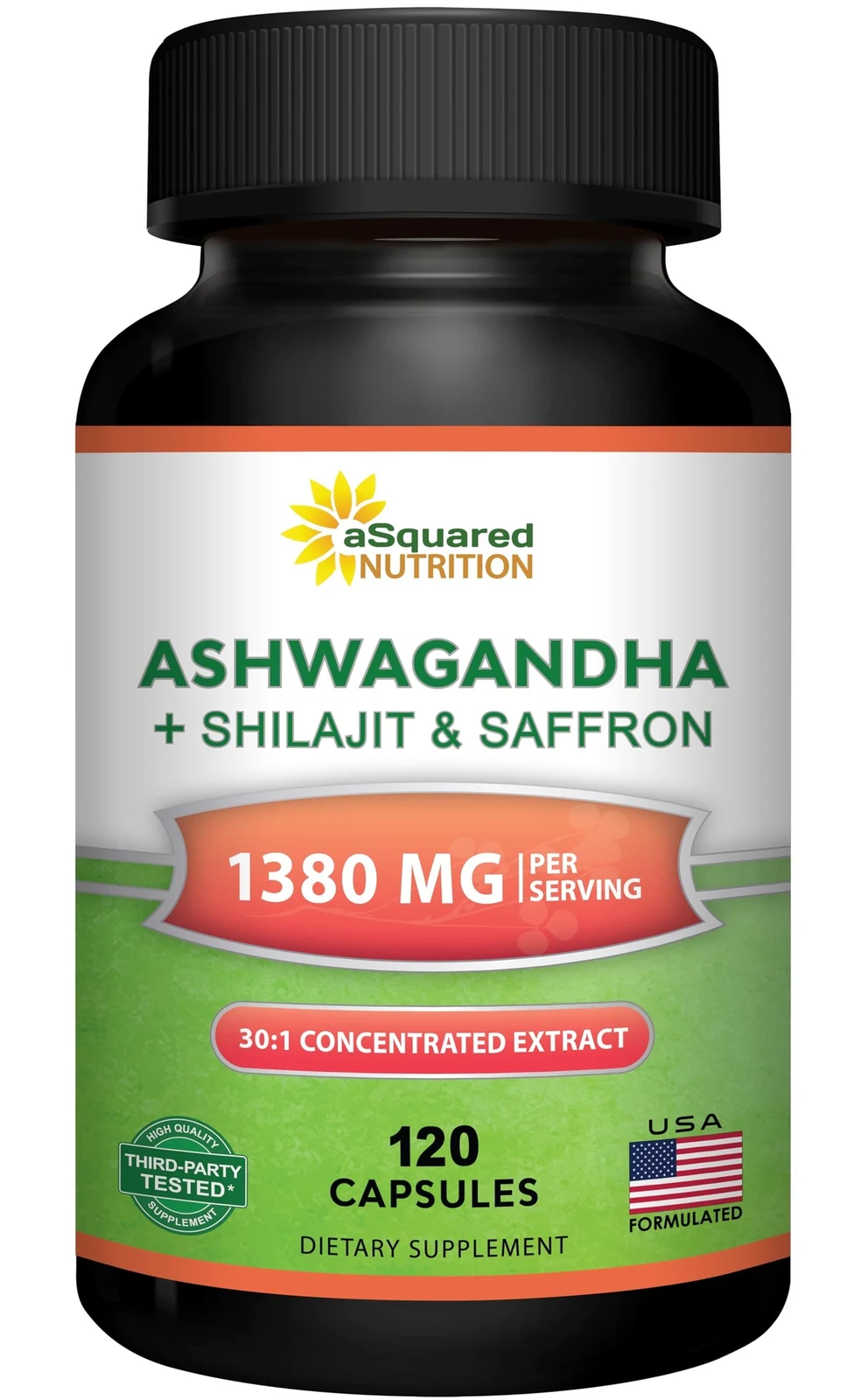
aSquared Nutrition took a different approach.
Its formula coordinates four distinct layers around the outcome people actually want: calmer under pressure, more capable during the day, and ready to wind down without caffeine or melatonin.
One formula. Four carefully chosen jobs.
Instead of building another one-note calm capsule, aSquared pairs a concentrated ashwagandha foundation with vitality, mood, and delivery support.
- 1,200 mg 30:1 ashwagandha root extract
- 150 mg shilajit for the vitality layer
- 30 mg 4:1 saffron extract for the mood layer
- 60 mg Tri-Lipid Matrix for the delivery layer

Chosen by a brand with tens of thousands of customer ratings
This is not a one-product label with no selling history. SellerRatings records 30,519 Amazon seller reviews for aSquared Brands and a 5.0 out of 5 seller rating as of July 2026.8
That record covers the wider aSquared catalog and answers one important trust question: tens of thousands of Amazon customers have already bought from and rated the seller.
The Calm + Drive Matrix
One-herb calm formulas are a one-dimensional answer. This four-part system covers the whole daily experience through calm, vitality, mood, and delivery.
Ashwagandha: the calm foundation
The two-capsule serving starts with 1,200 mg of 30:1 ashwagandha root extract. Ashwagandha is the ingredient with the deepest human evidence in this formula, including randomized trials on stress, cortisol, and sleep measures.23
Proof level: the strongest human evidence in the formula. The studies used specific preparations, so this supports the ingredient rationale rather than guaranteeing an identical product result.
Shilajit: the vitality layer
The formula adds 150 mg of shilajit, standardized to at least 50% fulvic acid. Purified, standardized shilajit has been studied in humans, which gives this layer a real research rationale instead of a fashionable name alone.6
The published strength after fatigue signal was mainly seen at 500 mg daily. This product declares 150 mg, so the study proves human research exists for standardized shilajit, not that this serving duplicates that result.
Saffron: the mood layer
The formula also includes 30 mg of 4:1 saffron extract. In one randomized, double-blind trial, 56 healthy adults took 30 mg of a specific standardized saffron extract for eight weeks, giving researchers a credible reason to keep studying saffron in the stress and mood conversation.7
The study gives saffron a credible ingredient rationale. It used a specific standardized extract, so it should not be treated as a finished product trial.
Tri-Lipid Matrix: the delivery layer
MCT oil powder, phosphatidylcholine, and alpha-GPC complete the declared 60 mg Tri-Lipid Matrix. This gives the serving a defined fourth layer instead of another long list of unexplained herbs.
What the label proves: the blend composition and amount. No finished product absorption study was supplied, so this page does not turn “delivery layer” into a clinical absorption promise.
The result is a stimulant-free formula built around a more useful goal: calm without a knockout, and vitality without another cup of coffee.
Why consistency matters more than a one-week test
The Calm + Drive Matrix is built for a steady daily routine, not random use on only the hardest days.
That matters because the ashwagandha studies were not one-week experiments. Trials in the NIH evidence summary commonly lasted six to eight weeks, and the sleep meta-analysis found more pronounced results after at least eight weeks.34
One bottle provides a full 60-day routine at the working two-capsule serving.
A consistent 60-day evaluation tells you more than three capsules taken during three chaotic mornings.
That means taking it only as directed. Keeping the rest of the routine reasonably stable. Paying attention to afternoon energy, bedtime, waking, mood, caffeine, and unwanted effects.
That gives you enough time to judge the pattern, not just one unusually good or bad day.
The Six-Month Consistency Bundle
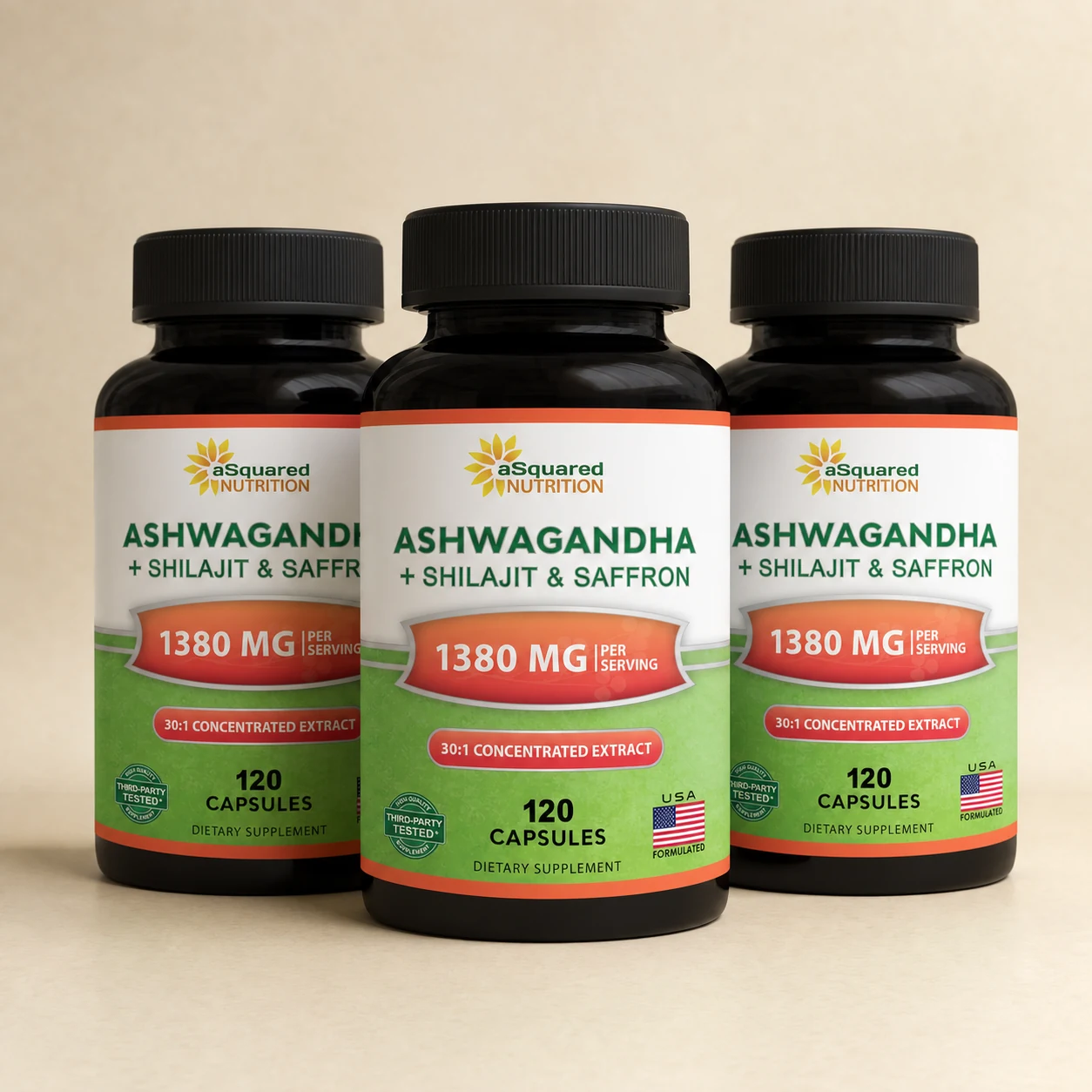
One bottle contains 120 capsules. At the two-capsule daily serving, that is 60 days. Three bottles put approximately 180 daily servings on hand, which covers a full six-month routine without waiting for two separate reorders.
- Three bottles, 360 capsules total
- Approximately six months at two capsules daily
- Two future reorder decisions avoided
- Free standard shipping included
- 30-day money-back guarantee
The three-bottle bundle removes the need to reorder every 60 days, saves $19.90 against three single bottles, and locks in the lower cost per day.
You can use the first bottle as your initial evaluation window. If you decide to continue, the next bottles are already there. If the bundle later sells through, you will not need to interrupt the routine or buy the remaining bottles separately.
The bottom line
Your 3 P.M. crash and 3 A.M. wake-up deserve to be considered together.
That is the real shift.
Stop chasing every difficult hour with a separate quick fix.
Look at the pattern. Then choose a formula designed for the whole problem, not one isolated hour.
Sources
- Sleep and Circadian Regulation of Cortisol
- Effects of Ashwagandha on Stress and Anxiety: A Systematic Review and Meta-Analysis of Nine Randomized Trials
- Effect of Ashwagandha Extract on Sleep: A Systematic Review and Meta-Analysis of Five Randomized Trials
- NIH Office of Dietary Supplements: Ashwagandha Fact Sheet for Health Professionals
- Understanding Plant-to-Extract Ratios in Botanical Extracts
- The Effects of Shilajit Supplementation on Fatigue-Induced Decreases in Muscular Strength
- Effects of Saffron Extract Supplementation on Mood, Well-Being, and Response to a Psychosocial Stressor
- aSquared Brands Amazon Seller Rating and Review Count
- aSquared Nutrition Current Product and Bundle Catalog
Paid advertisement for a dietary supplement. It is not personal medical advice. These statements have not been evaluated by the Food and Drug Administration. This product is not intended to diagnose, treat, cure, or prevent any disease.